 "
"
Team:UAB-Barcelona/Project
From 2009.igem.org

Contents |
Overall project
Abstract
|
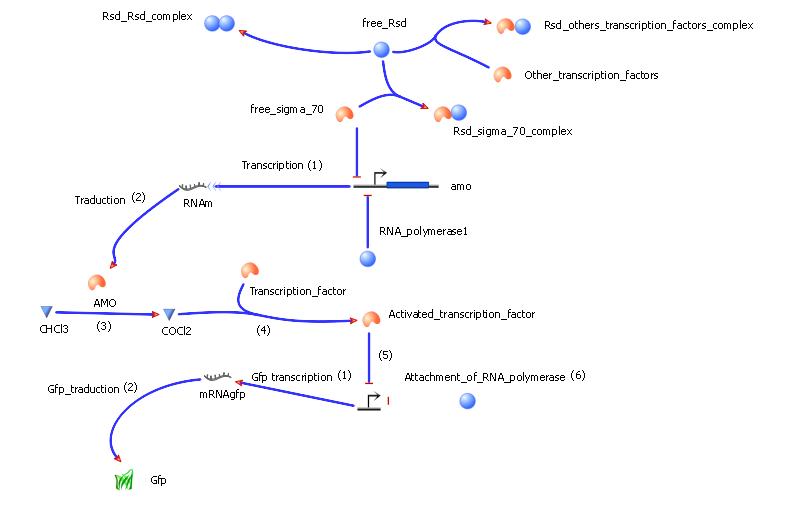
We are trying to develop a biosensor which can detect chloroform and other trihalomethanes in water. The idea is based on the ability of a recombinant Nitrosomonas europaea strain to detect those contaminants by expressing the exogenous gen of green fluorescent protein (gfp). It is thought that the capacity to detect trihalomethanes is due to ammonia monooxigenase (AMO), the enzyme responsible for oxidizing ammonia to nitrite. It seems that AMO recognizes chloroform nonspecifically and oxidizes it to phosgene, that is somehow able to activate mbla and clpb promoters and start the expression of GFP. Our aim is to transform an Escherichia coli K-12 strain with a plasmid containing the sequence that codifies for AMO and other plasmid containing mbla or clpb promoters and gfp, in order to achieve an E. coli strain which could detect chloroform and express GFP. |
|---|

What are trihalomethanes? Why are THMs so important?
IntroductionTrihalomethanes (THMs) are a group of volatile substances which are produced mainly in the drinking water treatment. Adding chlorine to water to disinfect it in water treatment plants generates some disinfection byproducts (DBPs) such as trihalomethanes, halogenated acetic acids (HAA) and others. It seems that the organic matter in water from rivers and reservoirs, especially substances such as tannins (fulvic and humic acids), through the process of oxidative chlorine, are precursors of disinfection byproducts. These products, especially trihalomethanes, are associated with risks regarding health and environment, and internationally linked to possible cancers such as colon and bladder, and adverse effects during pregnancy, including abortion and fetal growth retardation. One or more of methane’s hydrogen is chemically substituted by a halogen such as fluorine (F), chlorine (Cl), bromine (Br) or iodine (I). We can get the following compounds: CHF3 or trifluoromethane, fluoroform, Freon 23, R-23, HFC-23 CHClF2 or chlorodifluoromethane, R-22, HCFC-2 CHCl3 or trichloromethane, chloroform, methyl trichloride CHBrCl2 or bromodichloromethane CHBr2Cl or dibromochloromethane CHBr3 or tribromomethane, bromoform, methyl tribromide CHI3 or triiodomethane, iodoform, methyl triiodide
Health risks being in waterSpanish law admits that (since 1st January 2009) the presence of these compounds in tap water should not exceed 100 μg/L to be considered safe for human consumption. These values in many parts of Spain had been passing frequently in the past. In Barcelona and the metropolitan area for example, whose water supply comes mainly from two rivers, Llobregat and Ter, there were historically different qualities of water and presence of these compounds. In water coming from Llobregat river, the presence of trihalomethanes had been greater than 150 μg/L several times, while in water from the Ter river, without observing values so high, the concentration of 100 μg/L had been overcome easily. Water reaching a water treatment plant contains reducing agents (organic and inorganic compounds such as nitrites, ions of iron, lead and sulfur) as well as microorganisms and bacteria. Chlorine is applied in excess (about 2 mg /L) to oxidize these compounds and kill bacteria and also to remain a residual amount of chlorine in the water pipes. Its utility is to continue disinfecting the water after the treatment plant and until it reaches the consumer. This excess of chlorine reacts with organic compounds to form trihalomethanes. Several studies concluded that all water supply systems using free chlorine in its treatment contain at least 4 THMs in treated water: chloroform, bromodichloromethane, bromoform and dibromochloromethane.
Health riskMore recently it has been suggested that the accumulation of trihalomethanes in the water is considered risk for health and the environment, and even carcinogenic. Trihalomethanes have been linked in epidemiological studies with an increased risk of urinary bladder cancer, liver and kidney damage, or lung and breast cancer. The effect on human health can occur after long-term continuous intake. A report by the Public Health Agency of Barcelona, entitled "Health in Barcelona 2006," shows that it has been detected a maximum of 156.6 micrograms per liter of this carcinogenic substance produced by the drinking water treatment when it is captured in rivers. It should be remembered that the consumption of this substance for over 20 years has inevitably health problems, and cancer is one of them. Water is our source of life, it is necessary and irreplaceable, we must maintain proper control of the quality of our waters, working for the sake of citizens' health.
LegislationAccording to the rules of the European Union States the concentrantion of trihalomethanes should not exceed one hundred micrograms per liter of water for consumption. In Spain, Real Decreto 140/2003 of 7th February 2003 puts the limits of contamination legally permitted. Thus, the content of THMs that can have tap water from 1st January 2009 is reduced to 100 μg/L while in the United States the Environmental Protection Agency (USEPA) has established a legal maximum of 80 μg/L.
PreventionTreatments used for the sanitation of water are ozonation and chlorination. Chlorination is the one used in most countries due to the low cost of hypochlorite and its highly efficiency, and ensures an adequate disinfection of drinking water. In Europe, Mediterranean countries and the United Kingdom use chlorine gas in general, while the Nordic countries and Germany rejected the aroma and flavor using other products. Trihalomethanes are volatile compounds that can enter the human body by ingestion through the consumption of tap water, inhalation of vapors released into the showers or dermal adsorption during bathing or showering. So the best way to prevent their possible effects on our body is their direct elimination in the water used. At this point we must distinguish between potable water and water in the shower or bath.
Swimming poolsSwimming pool water needs to be disinfected to keep swimmers out from infections caused by microbial pathogens. Traditionally, sodium hypochlorite (NaClO) has been widely used for this purpose due to its moderate stability. However, the use of this compound has been reported to produce various halogenated organic compounds such as disinfection by-products (DBPs), since organic materials from various sources (perspiration, urine, mucus, skin particles, hair, lotion, etc.) are released into swimming pool water by swimmers. In addition, most pool waters are supplied with chlorinated surface water already contaminated with DBPs. The variations in the concentrations of DBPs in pool water have been suggested to depend on several factors: (a) the number of swimmers in pools; (b) the chlorine dose; (c) the bromide content; (d) the extent of outgasing of volatile DBPs; and (e) the use of DBPs-containing water (mostly chlorine-treated surface water) for pool water supply. The major products of disinfection using HBrO and HClO were bromoform (CHBr3) and chloroform (CHCl3), respectively. The addition of urine into the mixture containing humic material significantly reduce the overall formation of THMs, and this is attributed to the depletion of active free residual chlorine from the formation of less reactive chloramines. Air quality in indoor swimming pool facilities has emerged as an area concern with respect to human health. If there is not good ventilation in the buildings or swimming pool, it will cause more carcinogenesis from inhalation exposure to THMs. It is well known that THMs are volatile substances that can vaporize from water to environmental air depending on many variables, such as vapor pressure, water solubility, the water air contact area, etc. Chloroform is a highly volatile compound that can be inhaled in swimming pool environments and also readily absorbed through the skin. |
|---|
Project Details
The beginning of the laboratory workFirst of all, we asked Sayavedra et al if it was possible for them to send us some plasmid samples containing mbla and clpb promoters of Nitrosomonas europaea, and gfp gen. When they sent us the plasmids, we proceed to the transformation of E. coli DH5a competent cells by using a thermoshock protocol. After that, we started the assays while we were waiting for Nitrosomonas europaea culture to be sent. The assays consisted of measuring the fluorescence emitted by mbla, clpb and DH5α strains incubated with different chloroform concentrations after different times. MilliQ® or distilled water?After we checked the results, we accorded to change different parameters. We changed medium distilled water to milliQ® water because we though that the little amount of chloroform present in distilled water might be able to activate gfp expression. Also, we suspected that chloroform concentrations in test tubes could be modified due to its volatility, so we tried to completely fill the falcons in order to minimize the chloroform losses. Finally, we represented normalized fluorescence versus chloroform concentration. Kinetic studies with different incubation times and concentrationsThe aim of these experiments was elucidate how the incubation in chloroform of the microorganisms used affects in the quantity of GFP produced by our biological system. The two main variables to control were the time and the amount of chloroform added. The first one is related with the fastness of the network of reactions which constitute our system, and the second one shows if the biosensors would be able to be used in a quantitative way as well (the principal objective of our project). Inclusion bodiesA common limitation of recombinant protein production in bacteria is the formation of insoluble protein aggregates known as inclusion bodies. From a molecular point of view, inclusion bodies are considered to be formed by unspecific hydrophobic interactions between disorderly deposited polypeptides, and are observed as ‘molecular dust-balls’ in productive cells .The folding into a precise three-dimensional structure is a requisite for protein activity. However, under heat shock and other stresses protein folding can be impaired and folding intermediates then tend to associate through exposed hydrophobic patches. Individual polypeptide molecules are thus being trapped into growing oligomeric aggregates lacking the biological activity. The solutions proposed and tested are: the addition of chloramphenicol in low doses in order to stop the synthesis of protein and then put the culture in an isotonic solution such as PBS. The other one is decreasing the incubation temperature to decrease the protein synthesis rate. Otherwise an excessive expression of GFP will saturate endogenous machinary and it will probably form inclusion bodies. The next question to answer was: How long will it take to protein to fold properly? ...in other words…How long is it necessary to incubate in PBS? The usual time was 1 hour but a kinetic study in PBS was done. We took samples every 20 minutes after putting the culture in this medium and the fluorescence and DO600nm were measured. Theoretically, whether inclusion bodies are formed, the fluorescence will increase after some time. PCR performWe finally got ready to perform a PCR (Polymerase Chain Reaction) to amplify amo, mbla and clpb sequences. We took a sample of each PCR tube and did an electrophoresis to see how separate the DNA bands were, but the results were negative. We suspected that were due to an insufficient DNA mould, so we put more Nitrosomonas cultures in order to obtain more biomass. This would take approximately 10 days, and while they grew we tried a new experiment based on the following hypothesis taken from some scientific papers: bacteria may need at least 12 hours to detect the presence of chloroform. So that we started a new 12-hour-kinetik assay, measuring the fluorescence every 2 hours and a half until 12 hours. Chloroform concentrations of 30, 300 and 3000 µM were assayed. |
|---|
Results and discussion
|
RESULTS
|
|---|


MilliQ® or distilled water?Distilled water has a small amount of chloroform, and we thought it could be able to activate gfp expression. We made parallel experiments with both milliQ® and distilled water in order to discover if that amount could affect our research. So we made mediums and PBS solutions with those kind of water. Finally, results showed us that the difference in chloroform between the two types of water produced no observable variation in gfp expression PBSPrevious studies proved that sample incubation in PBS solution may amplify the fluorescence signal when working with GFP protein. However, when we were making our fluorescence measurement, we noticed that it was lower in samples which were incubated less. Then, we decided to do a kinetic experiment about how PBS affected our samples. The results showed that there was a top fluorescence at 30 minutes, but after this maximum, fluorescence declined with time. Thus the optimum time for incubation were 30 minutes. It is due to the small amount of GFP in our samples. If we had used GFP-full samples, the optimum time would be higher. VolatilizationWhen we performed the assays, one of the problems we had to think about was related to chloroform volatility. It was reasonable to suppose that chloroform concentrations could be modified due to that factor. Consequently, we tried to avoid chloroform losses by completely filling up test tubes, but it was useless. After that, a gas chromatography was done to check that fact; nevertheless, there was no appreciable variation in chloroform levels with time. This is a logic result because all chloroform concentrations we tested were under its maximun water solubility. All of these conclusions can be contrasted in the following graphic. Induction experimentFor the induction experiment we followed a series of steps: • The day before the tests we inoculated a LB medium with our bacteria. • The day of the tests: o We pelleted the culture and resuspended in new LB medium. o We added the chloroform in several concentrations, from 0 to 3000μL (0, 7, 33.5, 84, 100, 168, 300, 1000, 1500 and 3000 μL). The standard test used 0, 33.5, 84 and 100 μL. o We incubated the aliquots in different times, from 30 minutes to 120 minutes. The standar test used 30 and 90 minutes. o We pelleted again and resuspended in PBS. o We incubated 30 minutes in PBS. o We measured fluorescence. The highest concentrations turned out toxic to our cultures. This is reasonable considering they were higher than those which there are in drinking water. The tests were run with three strains, a DH5alpha E.coli, a mbla promoter-mutant E.coli and a clpb promoter-mutant E.coli. But results showed an increase in fluorescence with time in all the strains, thus there were no conclusive conclusions. AMOOur project was based on the ability of gfp-recombinant Nitrosomonas europaea strain to detect and metabolize chloroform, and thus express GFP. It’s supposed that N.europaea is able to do that due to the presence AMO, which is believed to recognize unspecifically this pollutant and oxidizes it to phosgene. Then, gfp expression would be activated. So that, primer sequences were dessigned in order to clone amo gene by PCR. Nevertheless, after performing the PCR, purification and electrophoresis, we could observe the absence of the expected DNA. It was obvious that something was wrong, and it was thought that it could be due to the small amount of “mould” DNA. Therefore a N.europaea strain was grown up, but it took us about two weeks. When whe had a suitable optical density, we proceed to repeat the PCR. Unfortunately, we reached the same results. This conducted us to conclude that there was a mistake designing primer sequences. So, we could not obtain an amo-recombinant E.coli strain, and thus we could not reach our goal. Inclusion bodiesAs it was mentioned above, we tried to add chloramphenicol in order to inhibit protein synthesis and avoid producing those inclusion bodies. However, we didn't obtain any evidence about this; even more, it seemed that chloramphenicol contributed to slightly decrease fluorescence signal. After that, we could check, by carrying out confocal microscopy, that there is not any inclusion bodies production. Thus, this fact could not affect neither gfp concentrations nor signal strength in our assays. |
|---|

CONCLUSIONS
|
The results we obtained in the different experiments agree with the pictures taken by the confocal microscopy: chloroform doesn’t change the GFP expression in the cells with mbla/clpb. We noticed that the expression with mbla promoter is higher than with clpb, it’s stronger in E. coli, although we couldn’t appreciate it in the microscopy. This make us think that both promoters are recognized by an E. coli transcription factor. Although ‘’E. coli’’ has its own clpb, its regulatory machinery can’t recognize Nitrosomonas ‘s one. To make the promoters work as expected, we should introduce the mbla regulons from N. europaea, that are unknown, and the clpb ones (it may be RpoH) |
|---|

